
AI in Homebuilding: 5 Takeaways from the GHBA Developers Council Panel
AI in homebuilding: five lessons from the GHBA Developers Council panel — including the $400K hiding in most builders' utility coordination
 UtilityOn Team
On May 6, the Greater Houston Builders Association brought together a panel at the GHBA Developers Council to talk about something every builder, developer, and engineer in Texas is trying to figure out: where does AI actually move the needle in homebuilding, and where is it still hype?
The room was a mix of skeptics and super-users. The panel — moderated by Vanessa Cole (Cole Klein Builders) — featured Kristal Casey (Unicorn Service Solutions), Erika Tolar (Strata AI), Aaron Alford (Long Lake), and Ben Rich (UtilityOn). Across an hour of discussion and live demos, a few clear themes emerged.
If you missed the session, here are the five takeaways most relevant to anyone running construction, purchasing, or land development in Texas right now.
1. AI eliminates friction, not judgment
The first myth the panel dismantled: AI is not coming for your land team's job.
Erika Tolar put it plainly. AI handles the transactional, repetitive data work — pulling GIS layers, parsing PDFs, modeling scenarios — that used to consume junior analysts for weeks. What it cannot do is read the room at a councilman's golf cart conversation. It cannot weigh neighborhood resistance, council sentiment, relationship capital, or the feel of a market at a specific moment in a specific submarket.
That distinction matters because it tells you where to deploy AI first. Anywhere your team is doing high-volume, rules-based coordination — that's where AI agents pay back fastest. Anywhere the decision turns on judgment, politics, or relationships — that stays human.
For most builders, the friction is hiding in plain sight: feasibility reports, permit cycles, plat reviews, utility coordination, follow-up emails, and the dozens of small handoffs between trades, jurisdictions, and providers.
2. Decision-grade AI looks nothing like ChatGPT
If you've used ChatGPT, Claude, or Gemini and decided you can't trust them with real money decisions, you're not wrong — and Tolar explained why.
Consumer chatbots fall short for builders in three specific ways:
- No source citation. You can't trace where the answer came from. (Perplexity does this)
- No validation layer. The model doesn't know whether its answer is high-confidence or a hallucination.
- No control over context. It's reasoning over what you typed, not your specific tract, district, or deal assumptions.
For an answer to be one a developer would actually act on — six, seven, eight figures of capital riding on it — it needs to cite sources, flag what it cannot confidently resolve, and route to a human at the right threshold. That's the "human-in-the-loop" pattern, and it's the difference between a probabilistic toy and an auditable business decision.
The takeaway for builders: when you evaluate any AI tool, ask the vendor exactly how they handle source citations, confidence flagging, and the security of your inputs. If they can't answer cleanly, keep looking.
3. The fastest AI wins start with a thought partner — not a tool stack
Aaron Alford has been technology-forward at Long Lake for years and was building Power Automate workflows before "AI" was the conversation. His advice for anyone in the room without a single AI subscription: start by using it as a thought partner.
Two specific patterns he uses daily:
- A "board of directors" project. Build dossiers on a dozen leaders whose judgment you trust, load them into a ChatGPT or Claude project, and bounce ideas off the synthetic board. They challenge assumptions without you needing to feed them proprietary data.
- A pre-mortem. Tell the model the project failed badly six months from now — lost money, lost the deal, whatever — and ask it how you got there. The list of risk factors it generates is a free pre-deal checklist.
Both patterns require zero new tools and zero coding. They just require you to stop treating AI like a search engine and start treating it like a colleague who's read everything.
4. Permitting is about to move faster — get ready for it
Houston's "no zoning" reputation is a myth, but the city and county are stacking new rules and overlapping jurisdictions every cycle. Kristal, whose Unicorn Service Solutions platform has been applying AI to plat and permit review since 2022, walked through what's coming.
A few headline data points from the panel:
- Harris County recently approved a roughly $1M AI pilot to speed up permitting.
- In a demo with the City of Houston Planning Department, Unicorn Service Solutions' tool removed an estimated 75% of a reviewer's plat-review workload in under two weeks.
- The federal Permit Act and Speed Act are giving local jurisdictions political cover to move faster on AI adoption.
For builders and developers, the practical implication is twofold. First, expect permit cycles to compress over the next 24 months — and expect "design by review" (submitting incomplete plans hoping reviewers will mark them up) to stop working. Second, the same AI that's about to help reviewers can help you screen your own submittals before they go in. The bad-actor penalty regime Harris County is discussing makes that pre-check more than a nice-to-have.
5. The biggest builder wins are AI agents handling boring, repeatable coordination
This is where Ben Rich, founder of UtilityOn, focused his panel time — and where most builders in the room have the largest, least-glamorous opportunity sitting in their existing workflows.
UtilityOn coordinates electricity and gas connections for new construction across Texas, working with over 300 builders and connecting roughly 30% of all new single-family homes in Houston. Half of the top 20 national builders are in the system. The company is essentially a case study in the "agentic" pattern Ben described:
- A custom-trained LLM built on over half a million builder-utility emails and the regulatory codes for CenterPoint, Oncor, AEP, TNMP, and every regulated utility in Texas. It's an energy expert that doesn't try to think outside its lane.
- AI agents that proactively chase turn-downs. When a meter set is denied because of an address mismatch, missing meter loops, an unpaid sidewalk permit, or a foreign pedestal, the system identifies the issue, emails the construction manager with exactly what to fix, and resubmits the order as soon as it's resolved.
- A staffing model that reflects automation: UtilityOn runs require one person per 7,500–10,000 homes. Traditional retailers run one per 1,500–3,000.
The headline number from the panel: a recent performance review with a major national builder’s single division building roughly 1,700 homes per year showed UtilityOn delivered approximately $400,000 in annual value — about $200,000 in eliminated operational cost, over $100,000 in stranded final-bill electricity charges driven to zero, and almost $100,000 in new rebate revenue back to the builder. All at no cost to the builder in deregulated areas, which cover about 85% of Texas.
The pattern is the broader lesson. The agents that pay back fastest are the ones doing the work nobody on your team enjoys: making outbound calls to utility call centers, filling out repetitive forms, chasing follow-ups, reconciling closings, and freeing your construction managers to actually manage construction.
What this means for Texas builders right now
Three practical moves coming out of the panel:
- Audit your team's friction. Where are construction managers, purchasing leads, and admins repeating the same coordination work week after week? That list is your AI roadmap.
- Pressure-test any AI vendor on three things: source citation, confidence flagging, and data security. If the answer is fuzzy, the tool is a liability, not an asset.
- Don't wait for permitting reform to compress your build cycle. Utility coordination, plat pre-checks, and feasibility screening are all available now and don't require you to change how your team works.
The builders who are pulling ahead aren't the ones with the largest AI tool stacks. They're the ones who picked the two or three workflows where AI is genuinely good today, and shipped.
About UtilityOn
UtilityOn manages utility connections for new construction across Texas — both regulated and deregulated markets, electricity and gas, temporary and permanent meters, plus closing-time handoff to the homeowner. We work with over 300 builders, including half of the top 20 national builders, connecting roughly 30% of new single-family homes in Houston.
Read next
More field notes from the UtilityOn team.
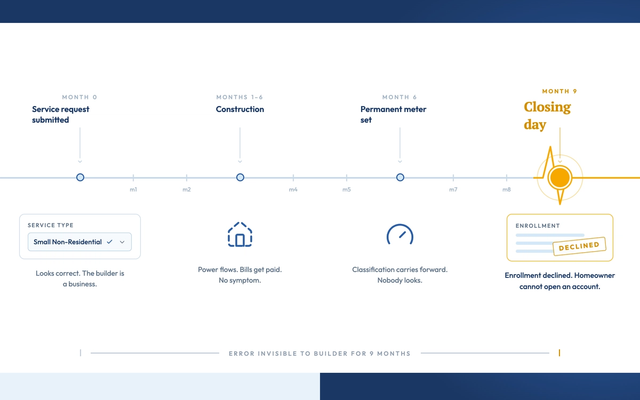
The Dropdown Menu That Shows Up on Move-In Day
A meter classified as Small Non-Residential looks correct all through the build. It only fails when the homeowner tries to turn on the power. Why Texas builders never see it coming.
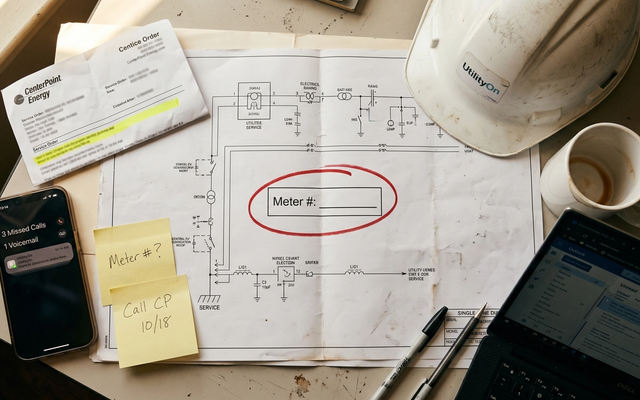
How to Avoid Delays on Your Permanent Meter When Adding Solar to a New Home Build
Rooftop solar on a spec home can add 60+ days to your permanent meter timeline. Here's what causes the delay, how to fix it, and how to avoid it entirely.

The $20,000 Lesson: Why Utility Connections Are the Silent Killer of Build-to-Rent Timelines
The $20,000 Lesson: Why Utility Connections Are the Silent Killer of Build-to-Rent Timelines. Takeaways from the IMN Residential Ground-Up Construction Forum, Spring 2026