
The $20,000 Lesson: Why Utility Connections Are the Silent Killer of Build-to-Rent Timelines
The $20,000 Lesson: Why Utility Connections Are the Silent Killer of Build-to-Rent Timelines. Takeaways from the IMN Residential Ground-Up Construction Forum, Spring 2026
 UtilityOn Team
The $20,000 Lesson: Why Utility Connections Are the Silent Killer of Build-to-Rent Timelines
Takeaways from the IMN Residential Ground-Up Construction Forum — Spring 2026
Panel: Speed Without Sacrifice: Strategies to Shorten Construction Timelines Session Date: Thursday, April 9, 2026 | 11:50 AM – 12:35 PM CT Event: IMN Residential Ground-Up Construction Forum, Houston, TX
At last week's IMN Residential Ground-Up Construction Forum in Houston, I sat in on one of the most useful panels of the event: Speed Without Sacrifice: Strategies to Shorten Construction Timelines. Moderated by Greg Huegel, Co-Founder of PK Capital Solutions, the session brought together four operators who collectively build across Florida, the Carolinas, and Texas — single-family, multifamily, build-to-rent, and everything in between.
The panel covered a lot of ground: project management software, turnkey trade partner strategy, cash flow discipline, incentive structures that cut cycle time by weeks. All of it useful. But the story that stuck with me — and the one I think every builder in the room felt in their gut — came from Daniel Gibbens, CEO of G6 Development Company. It was a story about utilities. And it cost him twenty thousand dollars.
The Story: 120 Days to Build, 30–40 Days to Wait for Power
Daniel was walking the panel through the difference between what carrying cost looks like on paper vs. what it looks like when your project actually hits the ground. Here's the situation he described:
- Built-to-rent community, 12 units. Built on schedule — 120 days from start.
- Three units already leased by the time construction wrapped.
- Then the project sat. For 30 to 40 days. Waiting on the utility company to connect power.
- Tenants couldn't move in. Rent couldn't be collected. Carrying cost kept running.
- Net impact: roughly $20,000 in lost lease revenue, plus the soft cost of a month of carry on a finished asset.
As Daniel put it on stage: "We got the project done in 120 days. Then we waited 30 to 40 days. At this point we had the BTR done. We had three leased. And guess what? We lost twenty thousand dollars because we were waiting on our utility company to connect power. Nobody paid the rent that month because they hadn't moved in yet."
Read that again. The crew hit the number. The trade partners hit the number. The project manager hit the number. And a utility meter — a thing the builder has almost zero control over once the order is placed — ate all the upside.
Brent Zande of Slate Building Group backed him up from the moderator seat: "You'd be able to be accountable in utilities so that they can kill target charge times. If you can't get the energy, the power on, it doesn't matter how much you are… water taps installed at the time of fashion — unfortunately all those things are out of our control once we put in the order at the beginning of the project."
That line — "out of our control once we put in the order" — is the whole problem in a single sentence.
Why Utility Delays Are Uniquely Expensive
On any other trade, if a sub slips a week, you have levers. You can split the job, bring in a second crew, re-sequence, escalate, pay to expedite. Trade partners compete for your work. You have leverage.
Utilities are different. A few things make the math worse on utility delays than almost any other bottleneck in the schedule:
1. They hit at the very end of the cycle. Utility connection sits at the back of the critical path — after framing, after inspections, after CO. Every dollar you've spent on the project is already deployed. Every day of delay compounds against a fully-loaded asset, not a half-built one.
2. The carrying cost is total, not incremental. On a BTR pad, a delay between slab and drywall costs you interest on work-in-progress. A delay between CO and meter-set costs you leases that are already signed. That $20K Daniel lost wasn't hypothetical revenue. It was signed-lease revenue that walked out the door because a tenant couldn't legally move into a unit without power.
3. You're not the customer — or at least, you don't feel like one. Most builders have no dedicated relationship inside the utility. You're calling a general line. You're one permit number in a queue. As Daniel put it on the panel: "Everybody at that utility office knew who I was." That's the cost of fighting through it without a repeatable process.
4. Deregulated markets add a second problem. In places like Texas, the utility delivers the meter, but a separate retail electricity provider has to be chosen, account opened, service activated. A missed handoff between those two parties is a completely silent delay — you don't find out until move-in day.
What the Rest of the Panel Got Right — and What They Didn't Say
Before I come back to utilities, it's worth pulling the practical playbook the panel built over 45 minutes. There was real substance in here:
On project management software. Brent described a 20–25 day per-cycle improvement from disciplined use of a PM tool — not because the software was magic, but because it forced visibility. "It gives you all the visibility of: are they logging in or out, are they checking in or out." Daniel, who's been piecing together Slack + CompanyCam + spreadsheets, was on stage actively shopping for an all-in-one (he was eyeing Trade4 — their accounting integration was the draw).
On turnkey trade partners. Brent made the cash flow case cleanly: when your plumber procures and installs, you're not fronting 100% of material cost on a 30–60 day lag. That's a massive working capital unlock as you scale. The flip side Greg raised — and it's real — is that the best framers and trim carpenters often won't go turnkey. So you end up with a hybrid: turnkey on the heavy, predictable trades (plumbing, HVAC, windows), self-procurement on the craft work.
On incentive alignment. This was the single most interesting operational take of the panel. Brent's shop writes bonuses into the client contract: if Slate Building Group hits under a target day count, the client pays a $15K bonus. If they're over, Slate pays $10K back. That pool flows straight to the field and office team. Result: average days from permit to CO dropped from somewhere around 108 to 86. Over a million dollars in bonuses paid out last year. Aligned incentives, measured in cycle days.
On standardization. "If you're building four, five, six of the same plan, it's rinse and repeat." Brent's move — spec'ing a benchmark house with a core vendor list and pushing those vendors to stock materials — is the unglamorous version of speed. It doesn't feel like innovation. It just compounds.
On the end buyer. Brent's boldest take: they pivoted their entire model away from retail end-buyers and toward investors and developers. Why? Because end-buyer finish selection was a cycle-time killer. "We had to pivot on the product. I'm not having to go into this and say, hey, you're not going to get this. No, you're going to get this." That's a strategic bet, not a tactic — but the cycle-time math is what drove it.
What the panel didn't really get to — and what I want to talk about now — is what you actually do about the bottleneck that killed Daniel's twenty grand.
The Playbook We'd Recommend for Utility Connections
At UtilityOn, this is literally all we do. We live inside the fragmented mess of Texas utility and retailer coordination — Oncor, CenterPoint, AEP, regulated gas, deregulated retail — and we manage the handoffs that cause exactly the situation Daniel described. Here's how we'd break the problem down for any builder running BTR or production volume today.
1. Stop treating the utility connection as an end-of-project task. It starts the day you pull the permit. Temporary meter coordination, permanent meter scheduling, retailer selection in deregulated territory — all of that should be a workflow kicked off at slab, not at punch-list.
2. Own the turndown process explicitly. Permit issues, utility turndowns, and account transfers are where 30-day delays actually come from. These are resolvable problems — if someone is dedicated to chasing them. In most builders' shops, that person is a starts coordinator juggling fifty other things, and turndowns fall through the cracks.
3. In deregulated markets, pre-select the retail provider. Don't leave it to the homeowner or tenant on move-in day. The builder-side retailer relationship is worth real money — it's how you keep move-in velocity predictable, and in many cases it's a revenue line for the builder (a per-meter rebate on every home connected).
4. Consolidate the tracking. One dashboard. One place where every home's utility status is visible across every community. The builders who do this turn a reactive fire drill into a two-minute weekly review.
5. Measure it. Track days-from-CO-to-energized as an actual KPI. If you don't measure it, you can't bonus against it. Brent's team figured out how to bonus against permit-to-CO. The next frontier is bonusing against permit-to-first-rent-check, which is the metric Daniel's $20K story is really about.
The Short Version
Speed without sacrifice was the theme of the panel, and the panelists gave a clean answer to most of the question: pre-plan everything, standardize, align incentives, own your trade partners. All of that compounds. All of it works.
But there's a gap at the end of the critical path that most builders don't engineer around — and it's the gap that cost Daniel $20,000 on a project his team had already done everything right on. If you're running build-to-rent at any scale in Texas, the days between your CO and your first rent check are the most expensive days in the entire cycle. They deserve the same rigor as everything else on your schedule.
That's the part we're trying to fix. If that resonates — if you've had your own version of Daniel's story — we should talk. It's a 20-minute conversation and we can probably tell you inside that call whether there's room to pull 20 to 40 days out of your BTR close cycle.
Book a demo: utilityon.com/signup Or grab 20 minutes directly: tidycal.com/m7gqyrm/30min-demo
About the Panel
Session: Speed Without Sacrifice: Strategies to Shorten Construction Timelines Date & time: Thursday, April 9, 2026 · 11:50 AM – 12:35 PM CT Event: IMN Residential Ground-Up Construction Forum (Spring) Topics covered:
- Which scheduling and project management tools are delivering real cycle-time improvements
- How builders are managing just-in-time materials and supply chain uncertainty
- Procurement, modular, or paneled systems providing real time savings
- Streamlining inspections and reducing delays without compromising compliance
- Where are the most common bottlenecks — and how to clear them
- How punch-list time impacts margins and overall project profitability
- What role does technology play in coordinating trades and sequencing work more efficiently
This article was written from a recording of the live session. Quotes have been lightly edited for clarity where transcription artifacts affected readability; the substance of each speaker's comments has been preserved.
UtilityOn manages utility connections and coordination for residential home builders across Texas. We work with production builders, custom builders, and BTR operators to eliminate utility delays, resolve turndowns, and generate rebate revenue on every meter. Learn more →
Read next
More field notes from the UtilityOn team.
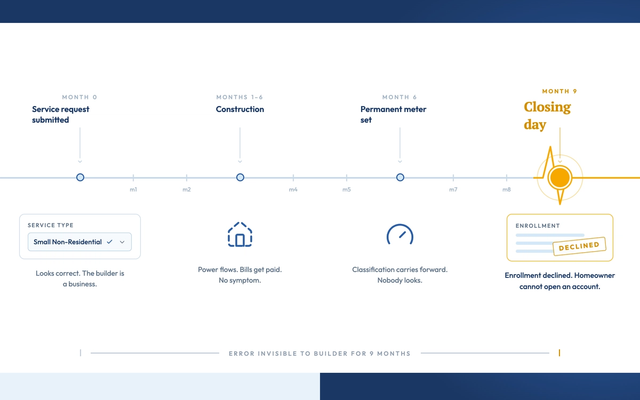
The Dropdown Menu That Shows Up on Move-In Day
A meter classified as Small Non-Residential looks correct all through the build. It only fails when the homeowner tries to turn on the power. Why Texas builders never see it coming.

AI in Homebuilding: 5 Takeaways from the GHBA Developers Council Panel
AI in homebuilding: five lessons from the GHBA Developers Council panel — including the $400K hiding in most builders' utility coordination
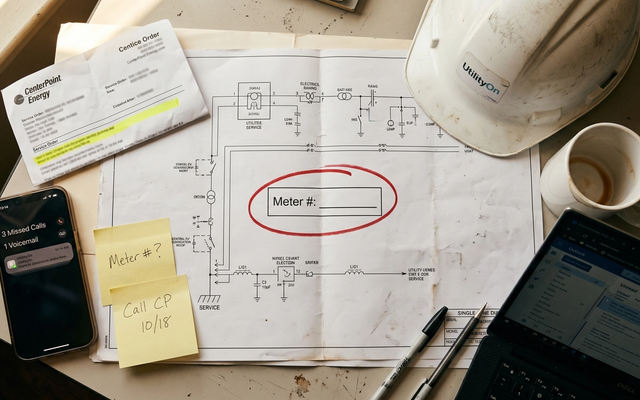
How to Avoid Delays on Your Permanent Meter When Adding Solar to a New Home Build
Rooftop solar on a spec home can add 60+ days to your permanent meter timeline. Here's what causes the delay, how to fix it, and how to avoid it entirely.