
How to Avoid Delays on Your Permanent Meter When Adding Solar to a New Home Build
Rooftop solar on a spec home can add 60+ days to your permanent meter timeline. Here's what causes the delay, how to fix it, and how to avoid it entirely.
 UtilityOn Team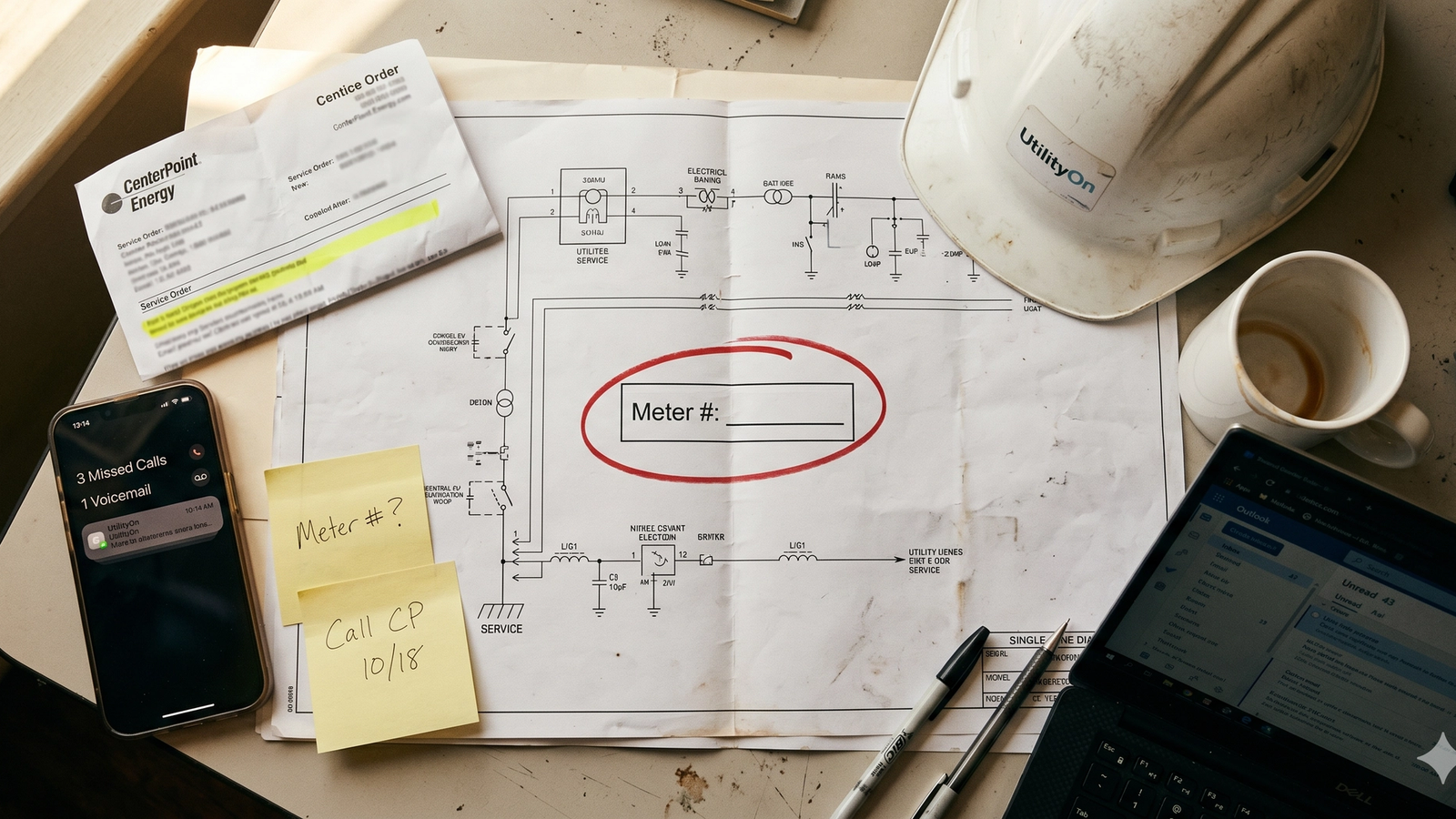
How to Avoid Delays on Your Permanent Meter When Adding Solar to a New Home Build
If you're a homebuilder in Houston — or anywhere in CenterPoint Energy's service territory — and your permanent meter is stuck on a finished home with rooftop solar, you're probably dealing with a problem you've never seen on a non-solar build.
The meter isn't delayed because something failed inspection. It's delayed by a paperwork loop between two CenterPoint departments that don’t coordinate, and it can add 6 to 8 weeks to your timeline if nobody intervenes.
This is what the problem looks like, why it happens, and what it takes to fix it. We run permanent meter connections for Texas homebuilders at UtilityOn, and we're seeing this pattern hit more projects every quarter as rooftop solar becomes standard in spec and custom home scopes.
CenterPoint runs two approval tracks on solar homes - and they don't talk to each other!
On a standard build without solar, the permanent meter process is straightforward: permit released, inspection cleared, meter set. Most builders know this process cold.
When the home has rooftop solar, CenterPoint adds a second track: the Distributed Generation (DG) interconnection review. Because the home will push power back to the grid, CenterPoint's DG team must review a one-line electrical diagram of the solar system, confirm that the inverter and disconnect match approved equipment, and issue an interconnection agreement before the meter can be energized.
The two tracks are run by different teams at CenterPoint. They do not share a queue or coordinate with each other.
The chicken-and-egg: CenterPoint wants a meter number that doesn't exist yet
Here is the loop that stalls projects.
CenterPoint's DG team tells the solar installer: "We can't approve the interconnection until you put the permanent meter number on the one-line diagram."
The meter doesn't exist yet. CenterPoint will not set it until the DG track signs off. The solar installer tries to escalate, gets bounced between reviewers, and the project sits.
This is not a one-off. We recently watched this exact loop play out on a project for Crafted Custom Homes in Houston, where a home sat without a permanent meter for 2 full months. Everything else was done — inspections passed, lot ready to close, rooftop solar installed. The only blocker was a paperwork loop between CenterPoint's meter team and CenterPoint's DG team.
The "ATS approval" hold that doesn't apply to your system
On homes with a solar-ready gateway instead of a traditional automatic transfer switch (ATS), CenterPoint reps will often still flag the permanent meter order as "ATS approval needed." This puts a hold on the order for a document that does not exist — the system does not contain an ATS.
The request bounces back to the electrician, who cannot produce approval documentation for equipment that isn't there. The order sits on hold. Nobody in the thread is wrong. Nobody in the thread has the authority to clear it.
If your project manager calls CenterPoint’s main support line, they’ll get the same answer the last six callers received. First-line support cannot resolve this hold.
How to fix a permanent meter delay on a solar home
Three things need to happen:
- Get CenterPoint's DG reviewer to accept the one-line diagram without the meter number. The reviewer has the discretion to note in the file that the meter number will be added post-set. But you typically need to reach a specific reviewer and walk them through the chicken-and-egg in writing.
- Clear the ATS flag by getting the system type documented in the inspection notes. A solar gateway is not an automatic transfer switch. Once the right person at CenterPoint sees that documented, the hold comes off.
- Push the permanent meter order back to inspection at a supervisor level. This is not a first-line support call. You need someone with the authority to re-queue the order once the holds are cleared.
Done in sequence, the meter can typically be set within a week of the holds being cleared.
Why does it still take weeks, even when you know the fix?
This is the part that surprises builders who assume this is a one-phone-call problem.
On the Crafted Custom Homes project, we diagnosed the path forward within days. The execution is what took two months, and the bottlenecks were outside anyone's direct control:
CenterPoint's scheduling and communication process. Every resubmission works its way back through the queue. CenterPoint does not proactively update you on order status, does not reliably notify you when a crew is dispatched, and will frequently mark an order as "scheduled" without actually working it. On this project, the order was marked ready three separate times before a crew was actually dispatched.
The solar installer's unfamiliarity with DG paperwork. The installer on this project had not previously filed a DG application correctly. Each round of corrections added another resubmission and another queue wait.
Neither of those bottlenecks can be solved by "knowing the process better." They get solved by absorbing every resubmission, every reschedule, and every miscommunication — and not letting any of it land on the builder.
What the builder actually experienced
While the two-month loop was playing out in the background, Curtis Lawson at Crafted Custom Homes was not calling CenterPoint supervisors. He was not coaching the solar installer through DG paperwork. He was not tracking which reviewer had which version of the one-line. He was building.
We took the process off Crafted's plate. We could not make CenterPoint move faster — nobody can — but we could make sure the builder was building instead of running the utility's process for them.
How UtilityOn works (and why it's free to the builder)
Builders always ask how we get paid if we don't invoice the builder. The answer is straightforward:
Retail electric providers pay us. When we connect a new home to the grid, we bring the REP a qualified new customer. They compensate us for that origination. The builder is not in the middle of that transaction.
We handle homeowner setup at closing. When the buyer takes possession, we work directly with them to arrange services — electric, gas, internet, security, the full stack. Your team does not have to coordinate accounts, move-in dates, or transfers.
When we assist the homeowner, the builder earns a rebate. For homes where we successfully help the new homeowner arrange their services, we issue a rebate to the builder. So the admin goes away and it becomes a line of income.
If you're stuck on a solar project right now
If you are reading this because you have a finished solar home sitting without a permanent meter, send us the address. We will tell you today whether we can have it moving this week or next.
If you're about to break ground on a home with solar, get us engaged at the permit stage — that is when the cost of prevention is lowest.
Either way, the conversation is free, whether or not you end up working with us. We would rather tell you "here's what to ask for" and have you fix it yourself than leave a Texas builder stuck.
Read next
More field notes from the UtilityOn team.
The Dropdown Menu That Shows Up on Move-In Day
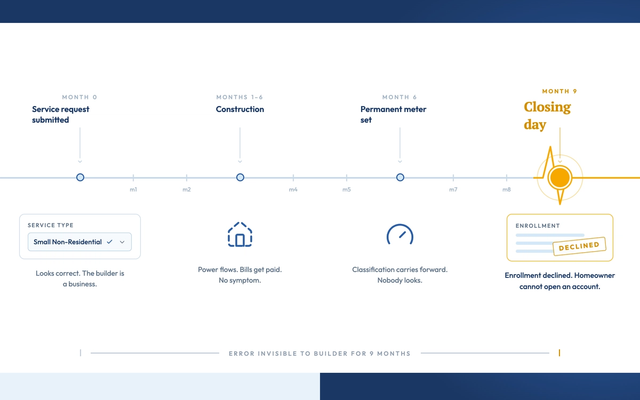
A meter classified as Small Non-Residential looks correct all through the build. It only fails when the homeowner tries to turn on the power. Why Texas builders never see it coming.

AI in Homebuilding: 5 Takeaways from the GHBA Developers Council Panel
AI in homebuilding: five lessons from the GHBA Developers Council panel — including the $400K hiding in most builders' utility coordination

The $20,000 Lesson: Why Utility Connections Are the Silent Killer of Build-to-Rent Timelines
The $20,000 Lesson: Why Utility Connections Are the Silent Killer of Build-to-Rent Timelines. Takeaways from the IMN Residential Ground-Up Construction Forum, Spring 2026