
The Dropdown Menu That Shows Up on Move-In Day
A meter classified as Small Non-Residential looks correct all through the build. It only fails when the homeowner tries to turn on the power. Why Texas builders never see it coming.
 UtilityOn Team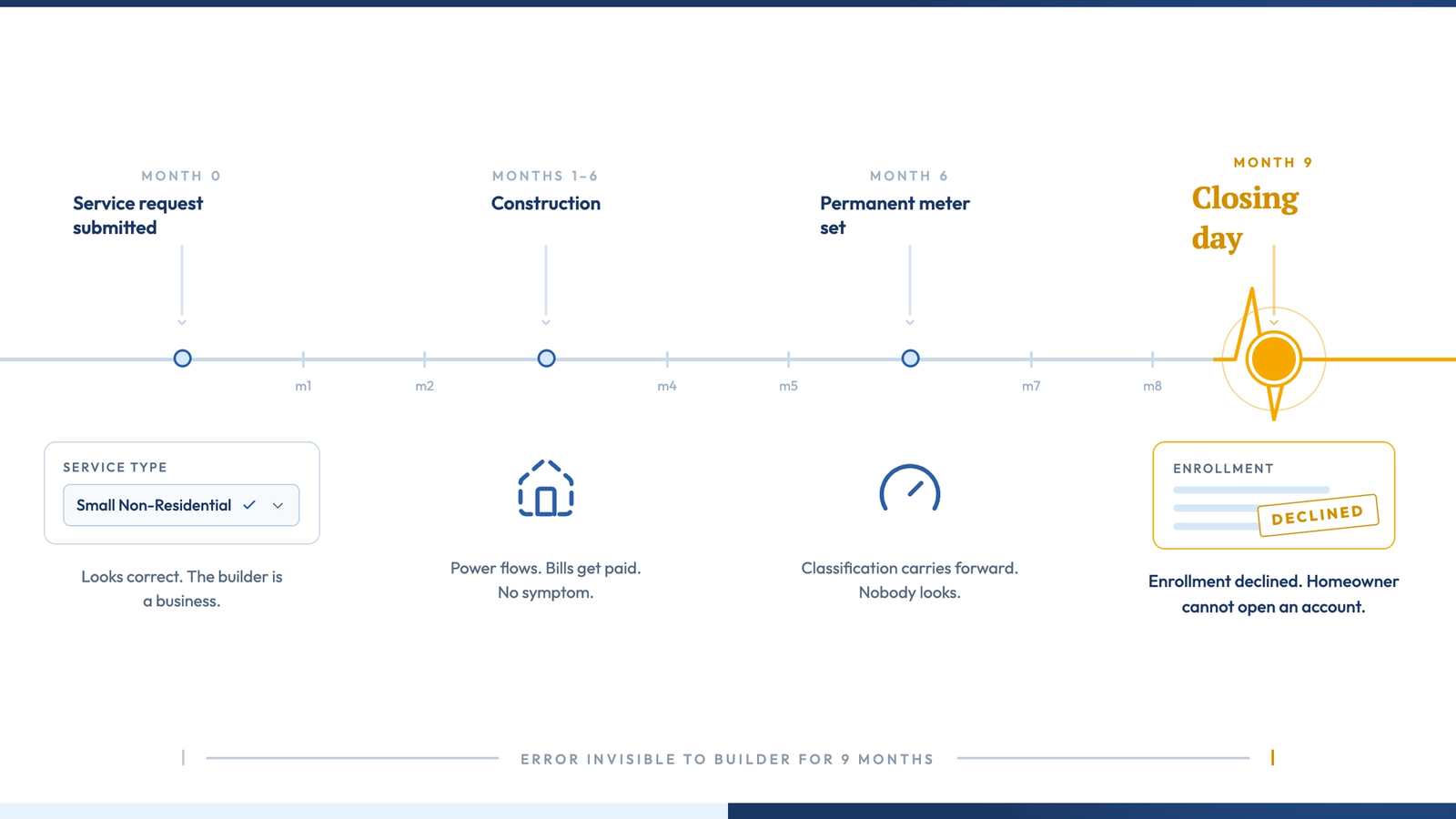
The Dropdown Menu That Shows Up on Move-In Day
A homeowner closed on a new build recently. Nine months of construction. Weekly updates from her builder. Photos at every milestone. A walkthrough where everything on the punch list got handled. By any measure, the builder had done the job well.
Then she called to set up her electricity, and the enrollment was rejected.
Not because of her credit. Not because of a paperwork error on her end. The meter at her house had been classified with CenterPoint as Small Non-Residential. A commercial meter. And no retail electric provider in Texas will enroll a residential customer against a commercial ESIID.
She could not turn on the power at the house she had just bought. And the first thing she was going to do about it was call her builder.
What actually happened
Every new home in a deregulated Texas market needs a service request submitted to the utility. On that request, someone selects a customer class.
During construction, the account belongs to the builder. The builder is a business. So when the form is filled out, Small Non-Residential looks like the right answer. Sometimes it is selected by a retailer's rep setting up the builder's account. Sometimes by a builder's own back office. Sometimes it carries forward from the temp meter into the permanent set without anyone touching it again.
The selection is not obviously wrong at the moment it is made. That is exactly the problem.
Because a builder meter at the permanent stage is not a builder meter for long. It is the homeowner's meter. It is going to be handed to a residential customer at closing, and residential customers cannot be enrolled on a commercial classification. The account class has to change before that handoff, and if nobody changes it, the handoff simply fails.
Why nobody catches it
Here is the part that makes this so persistent: the error is completely invisible to the only party who could fix it.
The builder's account works. Power flows to the lot. Trades run their tools. The bills arrive and get paid. From the builder's side, there is no symptom, no alert, no failed process. Nothing in the construction workflow surfaces a customer class field on a form that was submitted months earlier.
The error only becomes visible at the exact moment the builder loses the ability to see it, which is when the homeowner tries to open an account in her own name. By then the house is sold, the file is closed, and the person holding the problem is the one with the least ability to solve it.
An error that is silent to the party who caused it and loud to the party who inherits it will keep happening indefinitely, because there is no feedback loop. That is not a builder failure. It is a gap between two systems that were never designed to talk to each other.
What it costs, and who pays
The homeowner pays first. She has no account, no service in her name, and no clear explanation. She calls the retailer, who tells her the address will not enroll. She calls the utility, who tells her to speak to the account holder. She calls her builder, and reaches a sales rep or a construction manager who has never heard of an ESIID and has no reason to have heard of one. Every call she makes tells her the same thing in a different way: this is not my department.
That is what she will remember. Not the walkthrough, not the milestone photos, not the punch list that got closed out properly. She will remember the week she owned a house she could not put the power on in.
The builder pays too, in two ways. The obvious one is that the account stays where it is until the classification is corrected, which means the builder keeps carrying power on a home it no longer owns. The less obvious one is the more expensive one. This lands during the exact window when warranty tone gets set and referrals get decided. A homeowner who spends her first week as an owner on hold with three different phone numbers is not the homeowner who recommends you to a coworker.
Fixing it after the fact
It is fixable. A reclassification request goes to CenterPoint to move the ESIID from Small Non-Residential to residential. Once it processes, enrollment works normally.
The catch is that none of that is fast, and none of it happens while anyone is standing at a closing table. It requires knowing that meter classification is the cause in the first place, which is not obvious from the rejection message the homeowner sees. It requires knowing who at the utility handles the request and what they need to process it. And it requires someone to own the follow-up until it clears, because nobody at the utility is going to call and tell you it is done.
Most builders have no reason to have built that muscle. It is a once-in-a-while problem that shows up at the worst possible moment, and the knowledge required to fix it quickly is knowledge you only accumulate by seeing it dozens of times.
Catching it before it matters
The better answer is to never let it reach closing.
We flag this automatically. The moment a meter appears in our system classified as Small Non-Residential, it surfaces, and we open the reclassification with CenterPoint while the house is still being built. There is no deadline pressure, no homeowner waiting, no builder carrying an account it should have handed off. It gets corrected during a period when correcting it costs nothing.
This is one of the reasons we monitor every job through the full build rather than picking it up at closing. Utility problems in new construction are almost never dramatic. They are small administrative errors that sit quietly for months and then surface at the single worst moment in the customer relationship. Finding them early is not a technical achievement. It is just a matter of someone looking, consistently, at every home, on a schedule.
We connect more than 30% of new single-family homes in the Houston CenterPoint market, which means we see this pattern often enough to know it is not rare and not anyone's fault in particular. It is a dropdown menu with a reasonable-looking wrong answer, and no built-in way to catch it.
If you are a builder in a deregulated Texas market and you have never audited how your meters are classified, it is worth a look. The homes where it has gone wrong are not going to tell you. Your homeowners will.
Read next
More field notes from the UtilityOn team.

AI in Homebuilding: 5 Takeaways from the GHBA Developers Council Panel
AI in homebuilding: five lessons from the GHBA Developers Council panel — including the $400K hiding in most builders' utility coordination
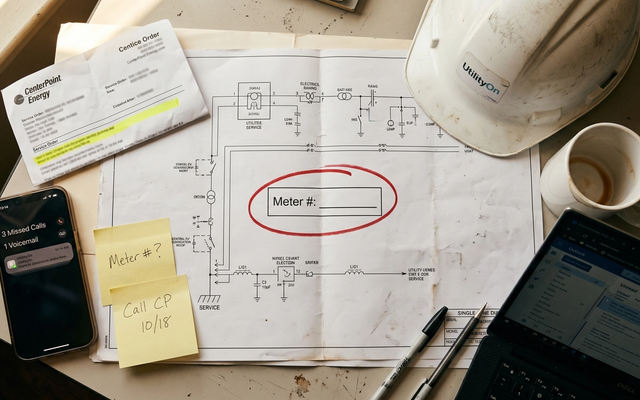
How to Avoid Delays on Your Permanent Meter When Adding Solar to a New Home Build
Rooftop solar on a spec home can add 60+ days to your permanent meter timeline. Here's what causes the delay, how to fix it, and how to avoid it entirely.
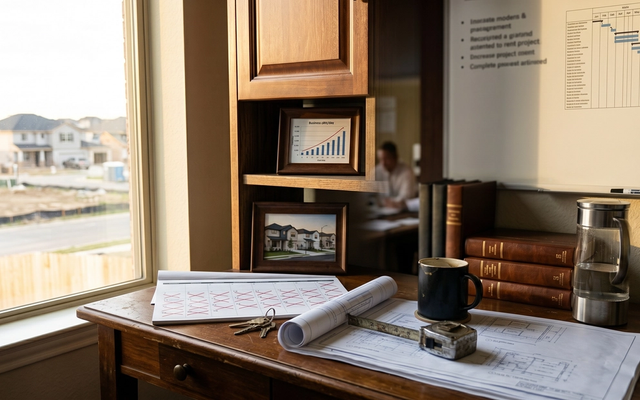
The $20,000 Lesson: Why Utility Connections Are the Silent Killer of Build-to-Rent Timelines
The $20,000 Lesson: Why Utility Connections Are the Silent Killer of Build-to-Rent Timelines. Takeaways from the IMN Residential Ground-Up Construction Forum, Spring 2026